Day 6 asked that we search for a poem in another language, absorb the ‘sound and shape of the words’ and use this as a basis for a poem. https://www.napowrimo.net/day-six-10/
Day five invites us to write a poem that ‘illuminates the juxtaposition between grief and joy, sorrow and reprieve.’ https://www.napowrimo.net/day-five-10/
Today’s poem is a first for me. The task was to write a triolet which is an eight-line poem with certain rules around rhyme and syllables. Take a look here for the finer details: https://www.napowrimo.net/day-four-11/
It’s the second day of National Poetry Writing Month and my offering this time didn’t take long to complete.
The prompt was a nudge towards the surreal which delighted me. It was suggested, like the Romanian-born poet Paul Celan once did, we write a series of surrealist questions and answers and from this, craft a poem.
I loved doing this, sitting in an area of our kitchen I call ‘poetry corner’, with a cuppa, relishing the Spring sunshine streaming in through the patio doors. My resulting poem surprised me.
This is my response to https://www.napowrimo.net/poets-start-your-engines/ and my first time taking part in National Poetry Writing Month, an annual project in which participating poets attempt to write a poem a day for the month of April. I feel inspired but acknowledge it’s a target I may not achieve. I can but try.
Any writing, including free writing, writing stories, poems, journaling, even letters, can improve our mood and wellbeing. You don’t need any special materials other than a notebook/paper and pen/pencil and you don’t need to write with good grammar or punctuation or be an accomplished writer to benefit, just a willingness to get your own words down on the page.
I am thrilled to be able to offer a series of five Writing for Wellbeing workshops (see my Writing for Wellbeing page for more information). Using a variety of writing prompts such as poems, objects, photos and visualisations, my aim is to help participants express themselves through writing.
By writing down our thoughts, feelings and ideas, things can become clearer, more understandable and gives a sense of perspective and control. Writing helps with personal development and this kind of writing has the potential for therapeutic benefit.
Writing can stir up many thoughts, feelings and strong emotions and so it is important to write what is within safe limits and to practice self-care. Sharing writing with other participants in the group is not obligatory.
These workshops are designed to use the medium of writing for self-discovery, affirming the ability to know what is needed to enhance personal wellbeing.
Benefits:
Experience a sense of release as words are written down on the page.
Helps people get in touch with themselves.
Helps gain a sense of control over unsettling emotions.
Increases self awareness and feelings of compassion for the self and for others.
Helps bring things into perspective and helps to see things from other perspectives.
Helps with feeling restored emotionally as people focus on what they already have and what they may need to improve their wellbeing.
This series of workshops is designed around 5 different ways to wellbeing which research has shown can improve our sense of feeling good about ourselves and our lives. Whilst including happiness, wellbeing has a much broader concept than moment to moment pleasures and includes how satisfied and fulfilled we feel, our sense of purpose, how in control we feel and how we evaluate our lives as a whole. Wellbeing is a process of discovery and is different for different people.
The origin of yoga has been lost in the midst of time. The closest we can get, is that it began in India over 5000 years ago. In today’s modern world, many people think of yoga as a physical practice, but this is not the case. The essence of yoga is about stilling the mind, emptying the mind. If you’ve ever tried to sit in meditation, you will realise this is extremely difficult to achieve and certainly for any length of time. The physical poses and the breathing we practice on the mat are tools to use to help still the mind off the mat.
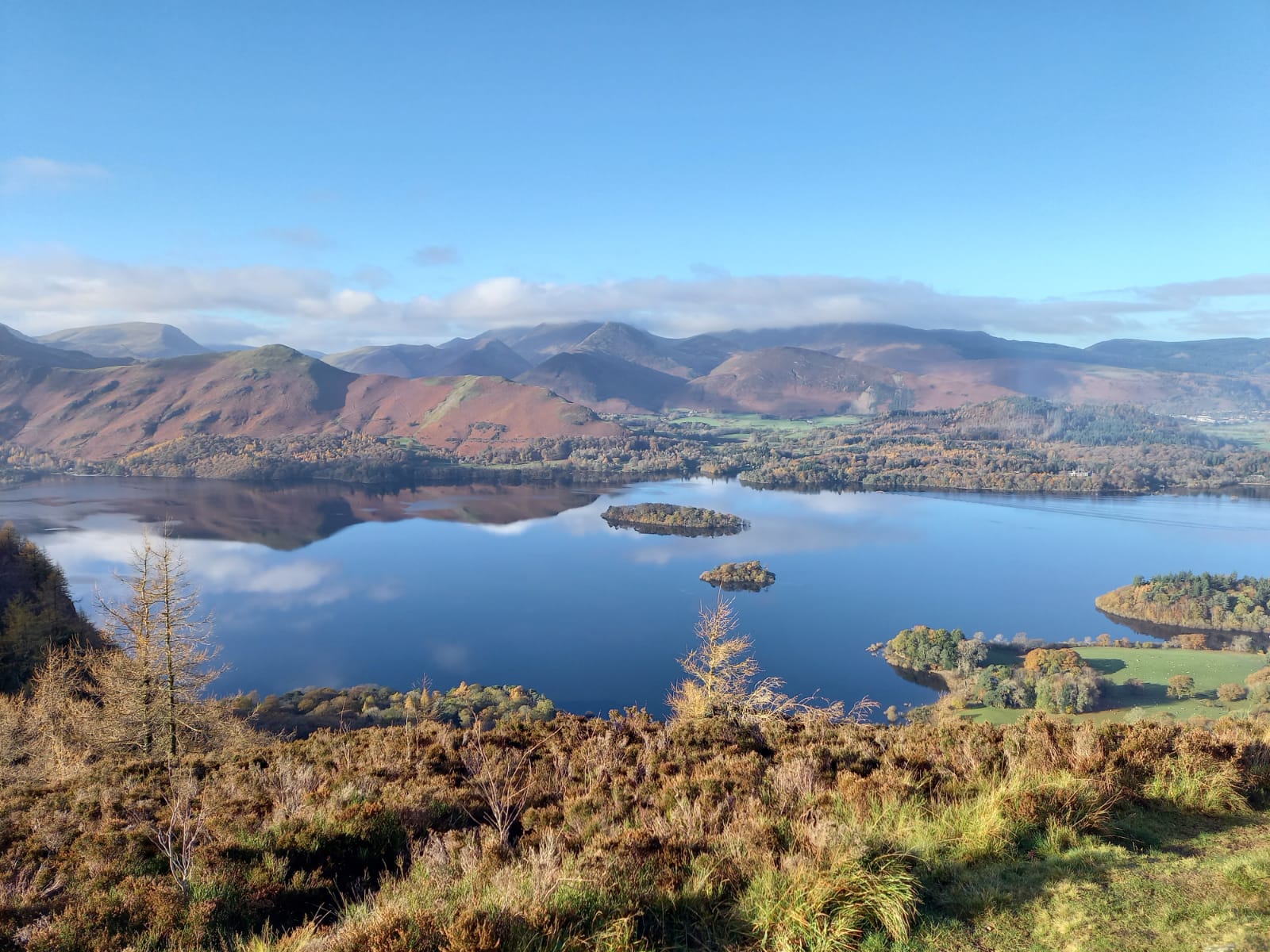
This week I am in the Lake District. On some of my walks, I have been alone, spending time on the hills and mountains practicing yoga. No, I haven’t gone into a downward dog on the summit nor knelt down on the fell to do a cat – I’ve been practicing emptying my mind and having a psychological clear out of all the rubbish I carry around in it in an attempt to find an inner stillness and tranquility.
In recent years, as I have developed my yoga practice, I have been focussing on taking what I practice on the mat, off the mat, and into my day to day activities. I have learnt I can practice yoga anytime and anywhere just by becoming aware and bringing myself back to the present moment.
I have a tendency towards an over active mind and if I am not careful, I can find myself ruminating about things (people, events, issues, situations, imaginings, ideas etc.) to the detriment of my wellbeing.
One of my daily affirmations is to have a clear, steady, quiet and alert mind. This is far easier to achieve when I’m walking in the Lake District than when I am at home. This week I have focussed on having a clear out of my mind and enjoyed peace and quiet when out on the fells. The challenge will be to maintain this sense of being when I leave this beautiful national park behind and return to my usual day to day routines.
It is therefore my intention whenever … :
I catch myself ruminating about my past (which I can do nothing about)
Worrying about my future (which I have no control over)
Getting stuck with an issue I can’t resolve
Churning over something in my mind I feel guilty about OR
Overthinking a decision I need to make, when all I need to do is listen to my heart and my gut,
… that I pause, watch my thoughts, allow them to float away and then reset. I will remember I don’t need to roll out my mat, practice asanas and breathing or sit cross legged in meditation … I can achieve this wherever I am and whatever I am doing. I don’t need to be solo walking in the Lake District.
All it takes is practice!
LIHazleton. Follow me on Twitter where I connect with other writers and all things writing. Follow me on Instagram if you love nature.



 LyndyH